How AI is transforming payment systems and helping overcome key challenges in the industry
- Thought leadership
- 5 Minute Read
- Last updated 10/03/2026


AI is changing how in-person and digital payments work behind the scenes. It helps teams spot potential fraud patterns earlier, identify routing or performance issues faster, automate operational tasks, and create smoother customer experiences.When deployed responsibly (with clear data controls and human oversight) AI within payments, including AI in digital payments and AI in cross-border payments, strengthens trust, and cuts cost, as well as making payments more predictable across every merchant and market.
Key Insights
-
AI moves payment decisioning from static rules to real-time context, improving accuracy and reducing unnecessary declines.
-
It automates operational pain points, such as reconciliation, data validation, onboarding checks that slow teams down and introduce cost.
-
Fraud models adapt to new behavior frequently (not instantly), detecting subtle anomalies across devices, channels, and borders.
-
Personalized prompts, smarter retries, and dynamic payment options shape better customer experiences and higher conversions.
-
Aevi’s In-Person Payment Orchestration Platform helps payment enablers gain the visibility and unified data layer needed for responsible AI deployment.
Don't have time to read more now? Sign up to our newsletter to get the latest insights directly in your inbox.
Every payment has that moment of uncertainty
A customer taps, swipes, or scans, and for a split second the system has to decide what to do - accept it or not. That moment has always been complex, but it has never been influenced by as many variables as it is today. Payments now run across a wider mix of devices, methods, networks, fraud checks, and operational workflows, all happening at once.
Older rule-based systems weren’t designed for this level of change or scale. They’re slow to adjust and hard to manage across different markets and merchant setups. That’s why AI is becoming useful inside payment operations - not to replace existing tools, but to give teams faster insight across both in-person and digital flows.
So the real question becomes: How do you make better decisions when the payment environment is only getting more complex?
This article explores where AI is having the most practical impact today, and what payment teams should think about before applying it across a full merchant estate.
Where AI delivers the most value in payments
The real strength of artificial intelligence in payment processing is its ability to make better decisions consistently at scale. For organizations exploring AI payments, even small improvements in cost and performance can add up quickly across thousands of merchants.
Let’s take a look at where AI is having the most impact…
Area of the Payment Flow
Fraud screening
Routing
Reconciliation
Support & CX
Risk checks
Traditional Approach
Rule-based, reactive
Static paths
Manual matching
Human-only
Batch processing
AI-Enhanced Approach
Behavioral, adaptive models
Real-time optimization
Automated, data-driven
Assisted triage + instant answers
Continuous, contextual
Value Gained
Fewer false declines, fewer losses
Higher approvals, lower cost
Faster close cycles
Faster resolutions
Better compliance and earlier detection
In practical terms, what this table is telling us is that AI is having the biggest impact in:
- Enhanced security
AI scans activity continuously and recalibrates as patterns shift. It helps reduce fraud losses while avoiding unnecessary friction for legitimate custom. And as these systems mature, it’s likely that AI-driven security measures will play an even bigger role in reducing fraud-related losses and countering increasingly sophisticated cybercrime. - Greater efficiency
Automation removes repetitive work in reconciliation, onboarding, and compliance tasks. This cuts manual errors and lowers the overall cost of running payment operations. - Smarter decisions
AI spots patterns across success rates, payment methods, geographies, and devices that are hard to see with manual analysis. Teams use these insights to:
- adjust routing strategies
- refine authentication and step-up rules
- forecast cash flow more accurately
- improve both in-person and digital journeys
- Better merchant and customer experiences
Fewer declines, clearer explanations, faster refunds, and easier support all add up to a smoother payment experience and stronger trust at the moment the payment happens.
When you combine these capabilities, the impact is bigger than any single use case. AI, therefore, helps payment teams move from reacting to issues to anticipating them, creating a smarter, more resilient payment operation across every merchant and market.
What to consider before implementing AI in payments
It’s understandable to think that adding AI anywhere in the payment flow will improve its efficiency, after all, the industry conversation often makes it sound endlessly capable. But in practice, AI only performs well when the environment around it is ready to support it.
If the payment environment is messy or missing key information, the AI won’t make good decisions, for example, when device data comes in different formats or when providers send incomplete transaction details.
To understand whether the environment is ready for AI, payment teams should ask themselves:
- Do we have visibility across every payment endpoint, or are there blind spots in the estate?
- Is our data consistent and high quality, or does it vary by device, provider, or market?
- Are devices, providers, and connections unified, or managed through separate tools with different standards?
- Where should AI be allowed to intervene, and where must human oversight remain in place?
- Is the orchestration layer stable and standardized, or does each merchant operate differently?
- Are we attempting to automate anything that sits inside a regulated or high-risk part of the flow, such as routing, authorization, or acceptance (where predictability and control must outweigh agility?)
Because, after all…
"AI in payments isn’t a tech challenge, it’s a mindset shift. Models are easy compared to defining what you can safely hand off, how you validate it, and how your data flows support that."
Eddie Johnson, CPTO, Aevi
It’s also worth recognizing that not all AI works the same way. Traditional machine learning helps with prediction and pattern recognition, while generative AI in payments supports tasks like summarization, explanation, and documentation. Both can add value, but each needs its own governance, data controls, and human oversight.
Why AI is becoming the foundation of future-ready payments
As payment estates grow more distributed (across terminals, devices, providers, and new use cases) teams face increasing operational pressure. Keeping everything aligned, updated, monitored, and performing as expected becomes harder as estates expand.
That’s why AI matters here. Not in the replacing people sense, but more in giving teams better tools to handle that complexity.
And that’s precisely where our in-person payment orchestration platform comes in, as it uses AI to be like a smart assistant that can:
-
- Spot unusual patterns in device or transaction data before they turn into operational issues
- Highlight trends across estates so providers can stay ahead of risks or performance shifts
- Learn from usage to predict where support or maintenance may be needed
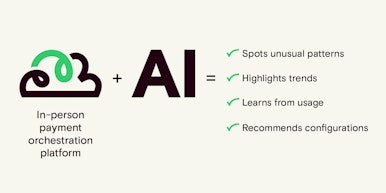

- Recommend the right configurations for new setups and flags anything that looks out of place
Because our orchestration platform brings every terminal, device, connection, and data point into one environment, these AI capabilities are easier to deploy, monitor, and scale as estates grow. Instead of adding more complexity, intelligence helps reduce it, giving payment providers a clearer, more predictable path as their networks expand.
Ready to explore how in-person payment orchestration supports responsible AI adoption? Let’s talk about what this could look like across your merchant network
Interested in reading more around this subject? Here are some useful articles…