EuroShop 2026: retail innovation is accelerating but integration still defines success
- Thought leadership
- 4 Minute Read
- Last updated 01/04/2026


Key Insights
- Retail innovation is accelerating across AI, automation, and self-service, but integration and scalability remain the defining challenges for retailers operating at scale.
- AI dominated the show floor conversation, yet its practical impact within in-person payments remains limited by regulation, security, and real-world deployment constraints.
- Enterprise retailers continue to struggle with fragmented payment capabilities across markets, limited acquiring flexibility, and solutions designed for only one or two countries.
- Hardware providers are moving closer to payments, but success depends on partnerships that can bridge devices, software, and the payment ecosystem without adding complexity.
- Regulation continues to set the boundaries of what retail innovation can realistically scale, particularly in grocery and age-restricted environments.
Don't have time to read more now? Sign up to our newsletter to get the latest insights directly in your inbox.
Last week (23-26.02.2026), our team attended EuroShop, where we had the chance to explore the technologies, conversations, and themes shaping the next phase of retail. From AI-driven systems and automation to self-service and connected store technologies, innovation was everywhere.

Beyond the show floor, a more grounded reality
But beyond the show floor, discussions with partners and technology providers revealed a more grounded reality. Retailers are no longer focused on individual innovations in isolation. The priority has shifted toward integration, scalability, and the ability to operate across complex, multi-market environments.
The emphasis has clearly shifted away from standalone deployments toward systems that can evolve over time without adding friction.
"The conversation has moved beyond individual solutions. It’s about building ecosystems that can evolve without increasing operational complexity."
Fabrizio Barni, Head of Retail EMEA, Aevi
AI everywhere, but not everywhere that matters
AI was the most visible theme across EuroShop, particularly in automation, robotics, and intelligent store operations. However, when conversations turned to in-person payments, the picture was far more restrained.
As Nadim Ghafoor observed during the event:
"AI was everywhere at the show, but in the in-person payment space specifically, it didn’t really come through in the same way."
Instead, payments discussions remained focused on reliability, security, and regulatory reality. Self-service continues to attract attention, but legal and compliance constraints still define what can be deployed at scale.
"You can see a lot of innovation being demonstrated, but regulation still dictates what’s actually possible on the shop floor."
Harry Sahota, Head of Partnerships, Aevi
Where innovation meets regulation
Several demonstrations highlighted the tension between technical capability and real-world feasibility. Age verification technology, for example, generated interest but also scepticism when considered in live retail environments.
As Nadim pointed out, in many markets regulation still requires human oversight, particularly in grocery and age-restricted retail. These constraints significantly limit how far automation can extend at the checkout, regardless of how advanced the technology becomes.
This reality shaped a more mature tone across conversations. There was less focus on experimentation for its own sake, and more emphasis on solutions that can actually scale across stores, countries, and formats.
Enterprise scale exposes structural gaps
A recurring theme across conversations at EuroShop was the complexity enterprise retailers face when operating at scale. While innovation continues to accelerate, many retailers are grappling with the realities of expanding across multiple markets, regulatory environments, and payment ecosystems.
Enterprise merchants typically operate far beyond one or two countries, yet scaling payments across borders remains a significant challenge. Discussions consistently highlighted the pressure retailers face when trying to balance consistency with local market requirements.
Common challenges surfaced repeatedly:
- Supporting payment capabilities cross-border.
- Managing relationships with more than one acquirer, often alongside existing contracts.
- Accommodating local payment schemes, regulatory requirements, and fallback needs
-
These challenges directly affect expansion plans and long‑term growth. As Nathan Jefferson noted, enterprise merchants don’t think in single markets, they expect solutions that can support the full footprint of their operations, not just a subset of it.
Several conversations reinforced that technology alone is rarely the blocker. Supporting enterprise retailers at scale requires experience navigating local markets, regulatory nuance, and acquiring landscapes that vary significantly by country.
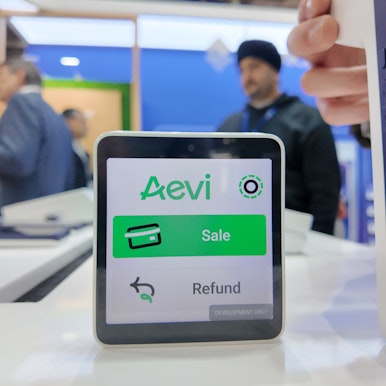

As Peter de Wit observed, many challenges emerge not from a lack of innovation, but from underestimating the complexity of operating across multiple markets, particularly when retailers need to maintain existing acquiring relationships and support local schemes alongside global expansion.
The takeaway was clear: as retailers expand, the value of working with partners who combine robust technology with real-world, local market expertise becomes increasingly critical.
Hardware moves closer to the payment layer
One of the more notable developments at EuroShop was growing interest from large hardware providers in embedding payments into broader in-store platforms.
As Nathan highlighted, what stood out was how open some of the major hardware providers were to getting involved in payments, viewing them as part of the wider in-store ecosystem rather than a separate layer.
At the same time, there was clear recognition that payments expertise remains specialized. Rather than owning the payment chain, many hardware vendors are looking to partner with platforms that can connect devices, software, and payments seamlessly.
A more realistic phase of retail innovation
EuroShop reflected a retail industry that is still innovating rapidly, but with greater realism. AI, automation, and self-service are no longer emerging ideas. The challenge now is making them work together across markets, within regulatory and operational constraints.
For payments, trust, flexibility, and integration remain central. As retail ecosystems continue to evolve, success will increasingly belong to those who can orchestrate complexity behind the scenes, while delivering simple, scalable experiences on the store floor.

Where are you headed this year?
EuroShop might be over, but there's plenty more events this year. The Aevi team would love to meet you at an event. You can find which event's we'll be attending here. Book a meeting with our team to find out how we can transform your in-person payments.
Interested in reading more around this subject? Here are some useful articles…