Fragmented hotel payment systems create hidden friction across guest experience, operations, and finance, making it harder for hotel groups to maintain consistency, visibility, and control as they scale. Unifying payments through a single orchestration layer brings everything together, allowing hotels to streamline operations, unlock better data, and deliver a seamless end-to-end guest journey.
Key Insights
- Fragmented hotel payment systems build up over time as properties, providers, and touchpoints expand, leaving hotel groups managing multiple disconnected payment relationships.
- Guests start to notice the cracks when payment details are not shared across systems, leading to repeated card requests and friction at key moments.
- Financial visibility is reduced as reconciliation becomes time consuming and error prone due to disconnected settlement data and reporting formats.
- Innovation is held back because adding new payment methods, scaling across regions, or enabling data driven capabilities like AI depends on unified, structured payment data.
Don't have time to read more now? Sign up to our newsletter to get the latest insights directly in your inbox.
One hotel, many keys…
Walk into any well-run hotel and it all feels efficient. At check-in, you’re handed a keycard - one simple card. It calls the lift, opens your room, powers everything once you’re inside, lets you pay for services along the way, gets you into the gym, and, in some swankier places, unlocks the spa and VIP lounge too.
From the guest’s point of view, it just works - one credential, everything connected - no friction, no second thought. That’s the hotel experience in a nutshell.
Now imagine if that keycard worked the way hotel payments do.
-
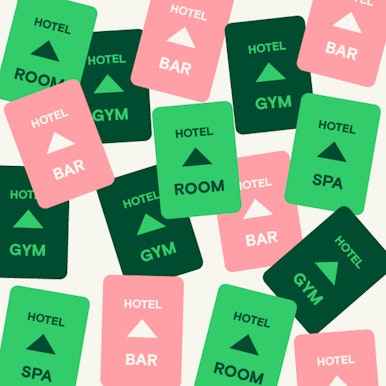
You’d have one key for your room, another for the lift, a separate one for the gym, while the spa issues its own, and the bar hands out a temporary pass that only works at that terminal.
That’s effectively what’s happening behind the scenes with hospitality payments: multiple locked doors, multiple keycards, and no single point of control. Behind every door sits a different provider, settlement file, support queue, and certification cycle.
Payments still go through, but every extra layer adds friction and limits how much

visibility teams really have across the business. And as hotel groups scale, that fragmentation starts to affect guest experience, reporting, and ultimately revenue.
To understand where that friction really comes from, and why it starts to affect revenue, we need to look at how fragmented hotel payment systems build up and where they begin to break down.
How the fragmentation builds
Complexity in hotel payments doesn’t appear overnight. A new property opens with a local acquirer (because that’s what hotels there use), while an acquisition brings legacy terminals that aren’t worth swapping just yet. Franchise locations already have their own payment deals, and before the group has a chance to standardize, a digital check-in system drops in, gateway included.
Each decision has a sensible rationale, but together they leave hotel groups managing five, eight, sometimes fifteen different payment relationships. We’ve written about this pattern before in messy payment setups across retail, but the difference with hotels is the sheer number of touchpoints.
- The front desk runs its own terminal and gateway
- The spa booking system sits on a separate setup
- The restaurant and bar use their own POS with a separate payment integration
- Digital check-in is handled by a different stack
- Mobile ordering adds yet another layer
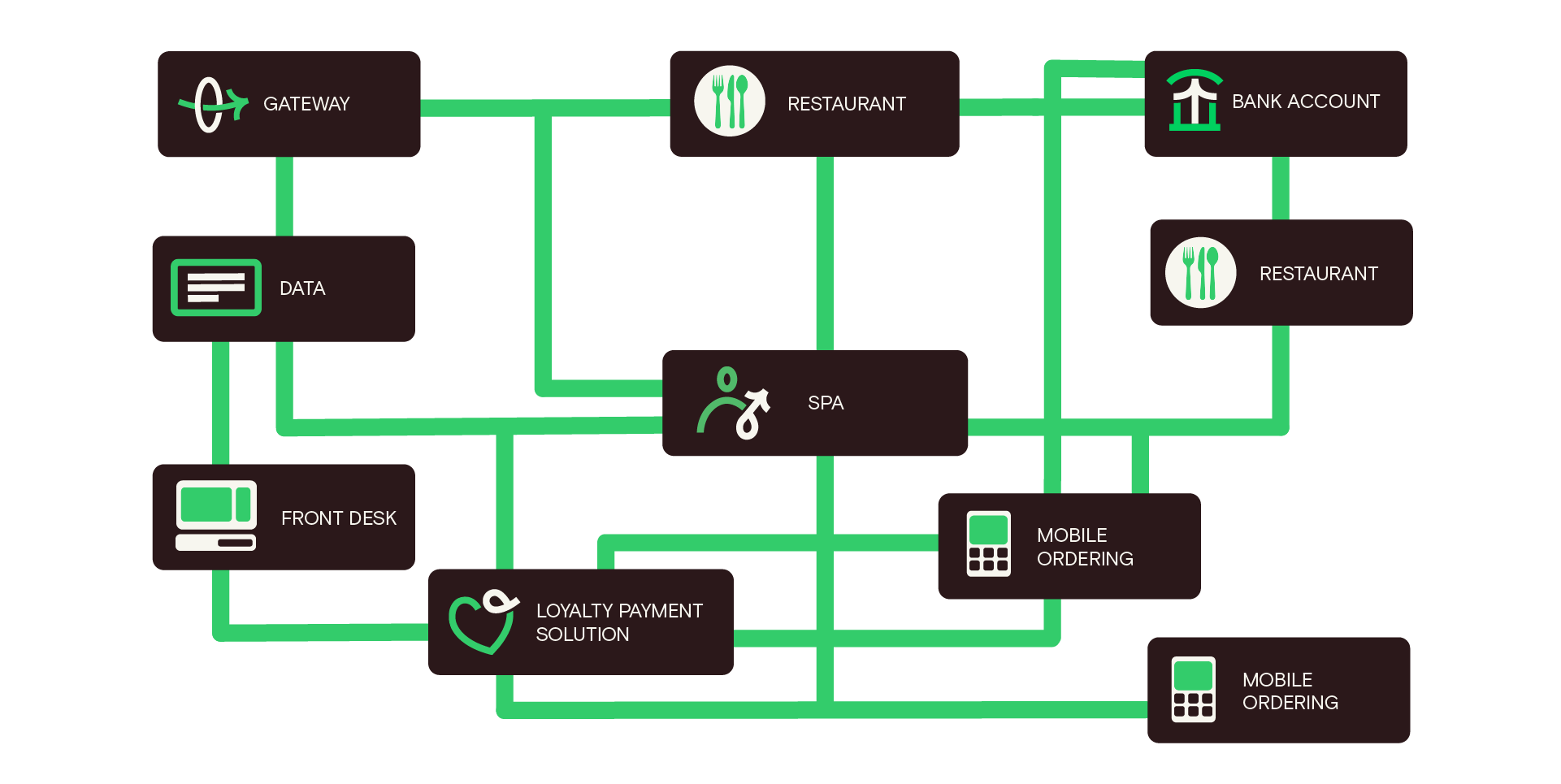
And that’s all just within a single property, let alone across a multi-brand franchise spanning dozens of countries.
The longer payment systems stay fragmented, the more the loyalty data ends up outside the hotel’s control. Third parties, including Online Travel Agencies, capture a bigger share of the guest identity, and every booking processed without a unified payment layer leaves another data point behind.
Where guests start to notice
Guests don't think about payment infrastructure; they think about whether their keycard worked.
Fragmented hotel payment systems make that “failed keycard” scenario more likely at every touchpoint.
A guest who stored their card during digital check-in shouldn’t have to present it again at the pool bar, but when payment tokens aren’t shared across systems, staff have no choice but to ask.
Pre-authorizations at the front desk don’t always communicate cleanly with the spa POS, turning a simple bill into a minor ordeal for the guest and an awkward scramble for staff. And wallets available at one property aren’t always offered at another under the same group - even though the guest is standing in a lobby with the same logo above the door.
None of this is catastrophic on its own, but each friction point chips away at the hotel experience. A checkout delay or a re-entered card number, might seem minor. But in hospitality, where the experience is the product, these moments add up quickly.
The more brands and touchpoints a hotel operates, the more these “failed keycard” moments multiply.
There's a deeper cost to all this too. Payment is the one moment every guest completes, making checkout the best opportunity to reinforce loyalty and connect to the guest's identity. When hotel payment systems are fragmented across vendors, that moment slips away.
Loyalty data isn't captured where it should be, and the guest relationship at checkout ends up tied to the system, not the hotel group.
The financial drag hiding behind the scenes
The guest experience problem is obvious when it happens, but the financial impact of fragmented payments is harder to see - and often far larger than expected.
When settlement files arrive from multiple acquirers on different timelines and in different formats, reconciliation stops being a routine task and becomes a full investigation. Bar tabs don’t always line up with front desk bills, spa transactions sit in separate reports, and fees, refunds, foreign exchange adjustments, and chargebacks are split across systems. Finance teams spend days piecing together a picture that should take hours.
Across Europe, the problem multiplies:
- Card payments settle at different speeds depending on the country
- Refunds follow separate schedules
- FX charges can appear weeks later.
- Reporting formats vary between providers, making data harder to align
On paper, revenue looks fine; in reality, teams are chasing missing references and explaining gaps that shouldn’t exist.
Operationally, this complexity shows up in the day-to-day running of the payment estate. Each device and gateway across the front desk, bar, spa, and other touchpoints comes with its own certification cycles, firmware updates, support paths, and maintenance requirements, all of which need managing.
A simple change (a new surcharge or adding a local wallet) turns into multiple projects, repeated across every provider and every market.
The innovation cost you're probably not measuring
There’s a third cost to fragmentation that often goes unmeasured: it slows down everything new.
Scenario
Adding a payment method
Adding new properties to a hotel group
Delivering an omnichannel guest journey
Enabling AI in hospitality payments and other advanced capabilities
What it involves in a fragmented estate
Returning to each provider, recertifying across different device types, and rolling changes out region by region
Each acquisition becomes a separate integration, with new providers to onboard and manage
Payment data sits in different places across booking, check-in, on-property, and checkout systems
Fraud detection and dynamic routing rely on clean, unified data, but systems produce siloed, inconsistent outputs
What can happen as a result
A pilot scheme that works in Amsterdam can take months to reach Madrid, while methods guests already expect sit waiting to be rolled out
The estate grows, but the complexity grows faster
It becomes much harder to deliver continuity, and guests end up needing to repeat payment steps
Analytics can’t use the data effectively, and issues become harder to spot
Adding a payment method
Adding new properties to a hotel group
Delivering an omnichannel guest journey
Enabling AI in hospitality payments and other advanced capabilities
The data is there, but the infrastructure makes it unusable.
Bringing hotel payments back under one keycard
The answer isn't to take all the locks off the doors; the existing systems mostly work, they're just not working together - and that gap is where the cost lives. Ripping everything out would create major disruption and tie up years in implementation risk. That’s not the way forward.
What’s missing is the equivalent of a single keycard behind every payment touchpoint: an orchestration layer.
-
This is exactly where Aevi’s orchestration platform comes in, connecting devices, providers, and payment flows into one unified system without replacing what’s already in place.
Transactions from the front desk, the spa POS, digital check-in, and mobile ordering all feed into a single system.


Tokens stay consistent, so a guest’s payment credentials follow them across touchpoints without the frustration of having to hand over their card again and again.
Settlement data lands in one place, linking room bills, spa charges, bar tabs, and other touchpoints, and routing rules can be updated once and applied everywhere instead of adjusting them market by market.
Crucially, this doesn’t remove local flexibility. Payment methods like iDEAL for Dutch guests, contactless in the UK, or local wallets where expected, can all be supported without separate integrations. New methods can be added once and rolled out across the estate, and transactions keep flowing even if a provider goes offline.
For PSPs and ISVs, the focus is changing. Hotels want a foundation that makes the estate easier to run and easier to update, without starting from scratch every time.
Giving every guest the right key
A global hotel should feel like one hotel. A guest who books online, checks in via an app, orders room service on their phone, and settles a spa bill at checkout should have a single, seamless payment journey - regardless of which brand and country they stayed with.
Fragmented hospitality payment systems make that hard, which makes unifying the payments estate essential.
Unifying the estate means making sure every door in the payments journey takes the same keycard - so guests can move through the hotel without friction, and teams can manage the estate without firefighting at every turn.
That means taking back control of payments so the hotel group owns the process, rather than leaving it split across vendors and legacy systems that have built up over time.
That’s exactly the kind of control our online and in-person orchestration platform is giving back to hotel groups.
Want to explore what a more unified approach could look like for your omnichannel hotel payments estate? Get in touch with our team today!
Interested in reading more on this topic?? Here are some useful articles...