Why modular stacks are making it easier than ever to build payments your way
- Thought leadership
- 5 Minute Read
- Last updated 07/05/2026


Payments are moving from fixed, bundled systems to modular stacks that businesses can shape around how they operate. Those that adopt orchestration and build adaptable payment infrastructure will be better positioned to respond to change and understand their customers more effectively.
Key Insights
- Traditional bundled payment models are breaking down as businesses need more flexibility.
- Modular stacks allow businesses to build payments around their operations by combining specialist components instead of relying on a single provider.
- Orchestration is what makes modular payments work, connecting components and enabling consistent control across the entire estate.
- The real value of payments is moving beyond transactions toward customer insight, with adaptable stacks giving businesses a competitive edge
Don't have time to read more now? Sign up to our newsletter to get the latest insights directly in your inbox.
Payments used to be something businesses plugged in and worked around…
...Now they’re designed to fit the business.
For a long time, payments infrastructure was a take-it-or-leave-it setup:
- A provider was selected.
- A contract was signed.
- A bundled payments system was put in place.
- The business built its operations around the limitations and structure of that system.
Flexibility wasn't part of the deal.
That approach worked when payment flows were relatively standard, and change was slower, but those conditions no longer apply, and the pace of change is catching a lot of businesses off guard.
Across the industry, the conversation has moved from "which provider do we use?" to "how do we build a stack that actually fits how we operate?"
That’s where modularity comes in.
Instead of accepting a bundled system, businesses are now assembling payments capability from separate, specialist components - routing, acquiring, orchestration, fraud, reporting - so the stack reflects how they actually operate, rather than how a provider structures its product.
This article looks at what’s driving that change, what a modular payments stack actually looks like, and the decisions businesses need to get right as they start building it.
Why the bundled model stopped working
The traditional approach to payments made sense for its time. Providers delivered end-to-end systems, businesses integrated once, and that was largely that. Payment flows were stable, and change was slow enough that a fixed setup could support a business for years without major issues.
That environment no longer exists.
-
New payment methods, new markets, new devices, and rising customer expectations have made the limitations of bundled solutions increasingly obvious, which is the topic explored in our interview with Silverflow’s COO Nigel Thacker.
When your provider controls the roadmap, your ability to respond is limited to what they're willing to prioritize. Expanding into new markets or adding a new payment method often means working around constraints rather than solving them directly.

That early simplicity in the traditional model is now where most of the friction in payments appears.
Why payment stacks are now built over bought
Today's landscape is more complex, but it’s also far more flexible. Tooling has improved, APIs are more standardized, and there’s a much broader ecosystem of specialist providers to work with. Building a custom stack still takes effort, but it’s no longer reserved for large enterprises with large engineering teams.
More businesses now have both the clarity and capability to take control of how their payments are built.
"They know what they want. They can go out and establish and create and build their own payment infrastructure."
Nigel Thacker, CCO, Silverflow
That gap in knowledge has closed, and payments infrastructure is being built differently as a result.
What a modular stack actually looks like
A modular payments model doesn’t replace one provider with another. It’s about breaking payments down into the individual capabilities behind them, and deciding how each of those should be handled.
Instead of a single bundled system, businesses are building a framework made up of separate components, each handled by specialist providers. Each part of the stack is chosen for its function and purpose.
At a high level, that stack usually includes:
- Acceptance - how payments are initiated across channels and devices
- Routing - how transactions are directed between providers
- Processing - where authorization and settlement take place
- Risk and fraud - how transactions are monitored and protected
- Data and reporting - how performance and behavior are understood
But these components don’t operate in isolation - they need to be coordinated across the entire estate.
That’s the role of orchestration. It links the components, allowing businesses to manage how payments flow between them.
Orchestration:

Controls how payments are routed

Standardizes integrations

Manages configuration across the estate

Allows changes to be made without rebuilding the whole stack
Without orchestration, modular payments become fragmented - meaning the components still function individually, but there’s no consistent coordination across the stack. With it, the stack stays structured and adaptable.
The result is a “super stack”, a flexible framework where new capabilities can be introduced without rebuilding the entire system.
“The future of payments is becoming more and more about software.”
Victor Padee, CRO, Aevi
The payment event itself is just the trigger; its value comes from how the system around it operates.
Where modular payments deliver real value
Payments stacks often fail in the same place because every change touches too much of the system at once.
Modular payments remove that dependency between parts of the stack.
When routing, provider connections, and payment flows are separated, changes stop being disruptive. A new acquirer can be introduced without replatforming, and a payment method can be tested in one market before being rolled out more broadly.
"The ability to adjust your payments stack quickly and easily is key."
Nigel Thacker
Online payments have generally offered more of this vendor-agnostic flexibility for some time, but in-person payments have lagged behind, held back by physical constraints and legacy systems.
-
That’s the gap Aevi is built to close.
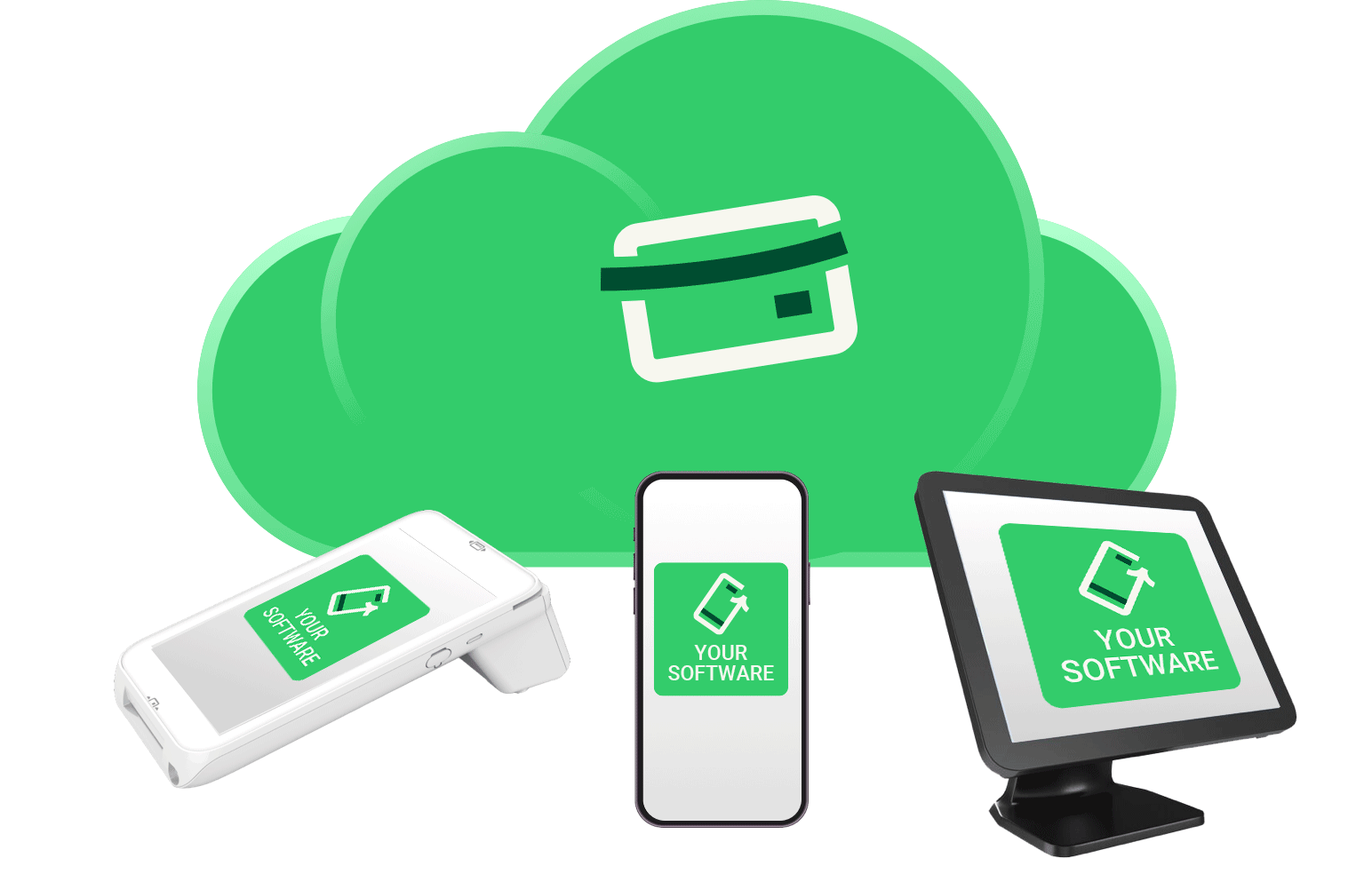
As the in-person payments layer in a modular stack, Aevi connects devices, acquirers, and payment methods through a single orchestration layer. This allows businesses to work across acquirers and terminals, while adding and updating payment methods without rebuilding integrations each time.
The processor's role is changing too
As payments move away from all-in-one providers, what’s expected of each part of the stack is changing.
“Having one provider for everything really doesn’t suit.”
Nigel Thacker
The providers gaining ground are those built for interoperability, exposing functionality through APIs, fitting into ecosystems they don’t control, and focusing on doing their part of the stack exceptionally well.
That same pattern applies across the stack.
“We don’t want to be everything for everyone. We focus on our niche.”
Victor Padee
Aevi handles in-person orchestration. Silverflow handles processing. It’s a match made in heaven.
The strength of a super stack comes from each component focusing on what it actually does well, not from any single provider trying to do everything.
Building the stack is becoming the strategy
Payments have moved from static infrastructure to something that needs to evolve with the business.
New providers can be introduced, flows adjusted, and new markets supported without starting again from scratch. Control sits with the business opposed to the provider.
"Businesses, banks, ISVs, and retailers are realizing that they need to create a payments experience that enables them to understand their customer better."
Victor Padee
That’s what’s fundamentally changing, and that's only possible with infrastructure flexible enough to support it.
Payments are becoming part of how a business understands what’s happening across its customers and channels, and how it responds. Once that expectation is set, going back to a fixed, bundled model stops making sense.
The advantage belongs to businesses that can change their payments stack as fast as the rest of their business.
Interested in reading more on this topic? Here are some useful articles...