When a vehicle pays for charging, fuel or parking on its own, the transaction passes through more hands than a normal checkout - OEM platform, wallet, PSP and issuer each own a piece. That spreads accountability, complicates authentication and consent, and leaves fuel and mobility retailers supporting another channel alongside everything they already run. Orchestration is what keeps that manageable.
Key Insights
-
In-car payments involve more parties than a traditional checkout. OEM platforms, wallets, PSPs and issuers each control a different part of the journey, which makes ownership and troubleshooting more complex.
-
Shared vehicles create new authentication challenges. Payment systems need to identify who is driving, which account should be charged and whether that person has permission to pay.
-
Consent has to move earlier in the journey. When a payment happens the moment a car connects to a charger, there's no tap or PIN at the point of sale, so approval has to be captured in advance.
-
Orchestration helps retailers add in-vehicle payments without rebuilding their setup. It gives fuel and mobility providers a way to connect new payment experiences with the infrastructure they already use.
Don't have time to read more now? Sign up to our newsletter to get the latest insights directly in your inbox.
When your car becomes part of the payment flow
You pull onto the forecourt to charge. The car recognizes the charger, starts drawing power, authorizes the payment and pushes a receipt to your phone before you've even unclipped your seatbelt. No card, no app, no tap.
That is the direction the market is already moving in - the same logic is spreading to fuel, parking, tolls, drive-throughs, car washes and roadside services. In each case, the vehicle is starting to behave less like a passenger cabin and more like a payment endpoint - one that happens to be moving at 70mph.
For fuel and mobility retailers, this adds another layer to the payment experience. It doesn't replace the terminal in the store or the SmartPOS at the pump, but it does mean another channel is joining the mix - one where the "device" making the payment is the vehicle itself. As more OEM-led experiences enter that mix, retailers will need to support them without allowing any single vehicle manufacturer’s platform to dictate how the wider payment journey works.
-
We won't cover the whole in-car commerce story here - for the broader picture of how it's developing, where drivers are using it and the fragmentation holding it back, read our companion piece, The future of in-car commerce (and the one thing holding it back).
This article focuses on the harder question underneath it: once the vehicle can pay, who actually owns that payment, and what does that mean for the retailers left supporting it?
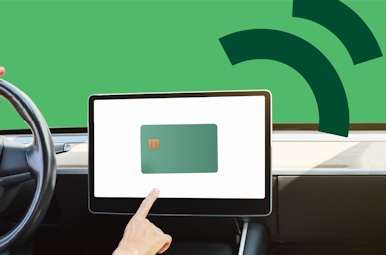

So, who actually owns the payment?
On the surface, the journey is a familiar one: a merchant requests payment and an issuer decides whether to approve it. The difference is that the credential now sits with the vehicle rather than with a person standing at the checkout - which creates more points where identity, authentication, consent or connectivity can fail, and spreads ownership of the transaction across several providers who each hold a different piece.
The vehicle manufacturer (OEM)
The OEM typically owns the vehicle's identity, its infotainment and connected platform, and often the digital wallet or customer account the payment credential is tied to. In many implementations, the OEM is what allows the merchant to recognize the vehicle and connect it to the right account.
Banks and issuers
-
Issuers remain the funding source behind the transaction.
They're still responsible for authentication and authorization, even when the request originates from a vehicle rather than a card or phone.


PSPs and payment providers
-
PSPs and orchestration providers support the routing, acquiring, settlement and fraud controls that sit between the OEM platform and the issuer, doing much of the same work they'd do in any other payment flow - just with a different starting point.


Merchants
Merchants, from charging networks and parking operators to fuel and mobility retailers, remain responsible for delivering the service and supporting the customer experience. That includes handling refunds, receipts and other post-payment issues - even though they may never see the card or interact with the driver directly.
For retailers, the commercial challenge isn’t simply knowing who owns each layer, but supporting reliable OEM-led payment journeys while retaining visibility into each transaction and control over the wider experience - all without becoming dependent on a single vehicle platform.
Unlike a traditional card-present transaction, where the merchant, PSP and issuer make up most of the picture, in-car commerce adds a whole additional layer of OEM infrastructure sitting between the customer and the point of sale.
The reality is that no single party owns the transaction from start to finish. Each participant is responsible for a different part of the payment journey, which can make accountability less clear and failed payments harder to resolve. When a credential is declined, consent has expired, or a vehicle fails to identify itself mid-session, the system still needs a clear fallback and a clear owner for the fix.
Why vehicles create new payment challenges
Much of the conversation around connected vehicles focuses on security, but the more immediate challenges are practical ones, about who's paying, how they consent to it, and how that gets confirmed when there's no card being tapped.
Who is actually making the purchase?
A vehicle can be driven by an owner, a partner, a colleague, a fleet driver or a rental customer, and the payment system needs to know which of those is making the transaction, and on whose account. That's a very different problem to a phone, which almost always belongs to a single, known user. A fleet vehicle adds another layer of complexity, since the payment may need to be linked to a driver for expense purposes while the transaction itself is settled through the business.
Consent becomes more complicated
Automatic charging, automatic tolls, subscriptions and on-demand vehicle features all raise the same question: how does someone actually approve spending in these scenarios? If a payment happens the moment a car connects to a charger, there's no opportunity to tap a card or enter a PIN - meaning consent has to be captured earlier in the journey, with clear rules around when payments can be made and under what conditions.
Cars are shared devices
Vehicles are regularly used by more than one person, which changes how authentication needs to work. The payment setup has to recognize who is behind the wheel at that moment and whether they're authorized to pay.
Authentication doesn't always happen at the moment of payment
With an in-vehicle payment, much of the heavy lifting happens before the customer reaches the point of purchase. The vehicle may already be linked to an account, the payment credential tokenized, and the vehicle established as a trusted device.
-
Strong Customer Authentication (SCA) can be applied during that earlier setup process where required, rather than at the charger or pump.
This is different from in-person payments, where authentication and the transaction happen in the same moment.


Why fuel and mobility retailers need to support more than one checkout
In-car commerce doesn't replace the payment options that already exist. Forecourt terminals, store checkouts, and SoftPOS all continue to play an important role - while the vehicle becomes another point where payments can happen.
Customers will continue to choose different ways to pay depending on the situation, so retailers need the flexibility to support each journey without creating separate systems for every channel.
That means having payment infrastructure that keeps experiences consistent while giving retailers visibility across transactions as new ways of paying emerge.
Where orchestration fits in for retailers
The more ways customers can pay, the harder it becomes to manage each payment experience separately - and the OEM layer we've just described is one more provider relationship to absorb. Fuel and mobility retailers may need to support everything from card payments and mobile wallets to fleet cards, open banking, in-vehicle payments, and whatever comes next.
Treating every new payment method as a separate integration quickly creates more complexity, with different providers bringing different reporting and operational processes. A payment orchestration layer helps retailers add new payment experiences without adding the same complexity underneath: working with different providers across different markets, keeping reporting and operations consistent across channels, and avoiding being locked into one payment stack - whether that's an OEM or another provider.
For a network already juggling forecourt terminals, in-store payments and app-based journeys, that's the difference between folding OEM platforms into the wider setup and rebuilding the payment stack every time a new experience appears.
This is the type of situation Aevi's orchestration platform is designed for. Our device-agnostic, vendor-agnostic approach is built for complex payment environments - including those where "in-person" no longer means paying at a physical terminal.
The future of commerce might not happen at the checkout
The checkout is becoming less of a fixed point and more of a connected experience. For mobility retailers, that means having the flexibility to support new ways of paying alongside the experiences customers already use - without creating another disconnected payment setup behind them.
Aevi helps providers build that flexibility into their payments setup. Get in touch with our team to explore what that could look like for your business.
Interested in reading more around this subject? Here are some useful articles…